Thread Percentage Calculator and Thread Engagement Chart
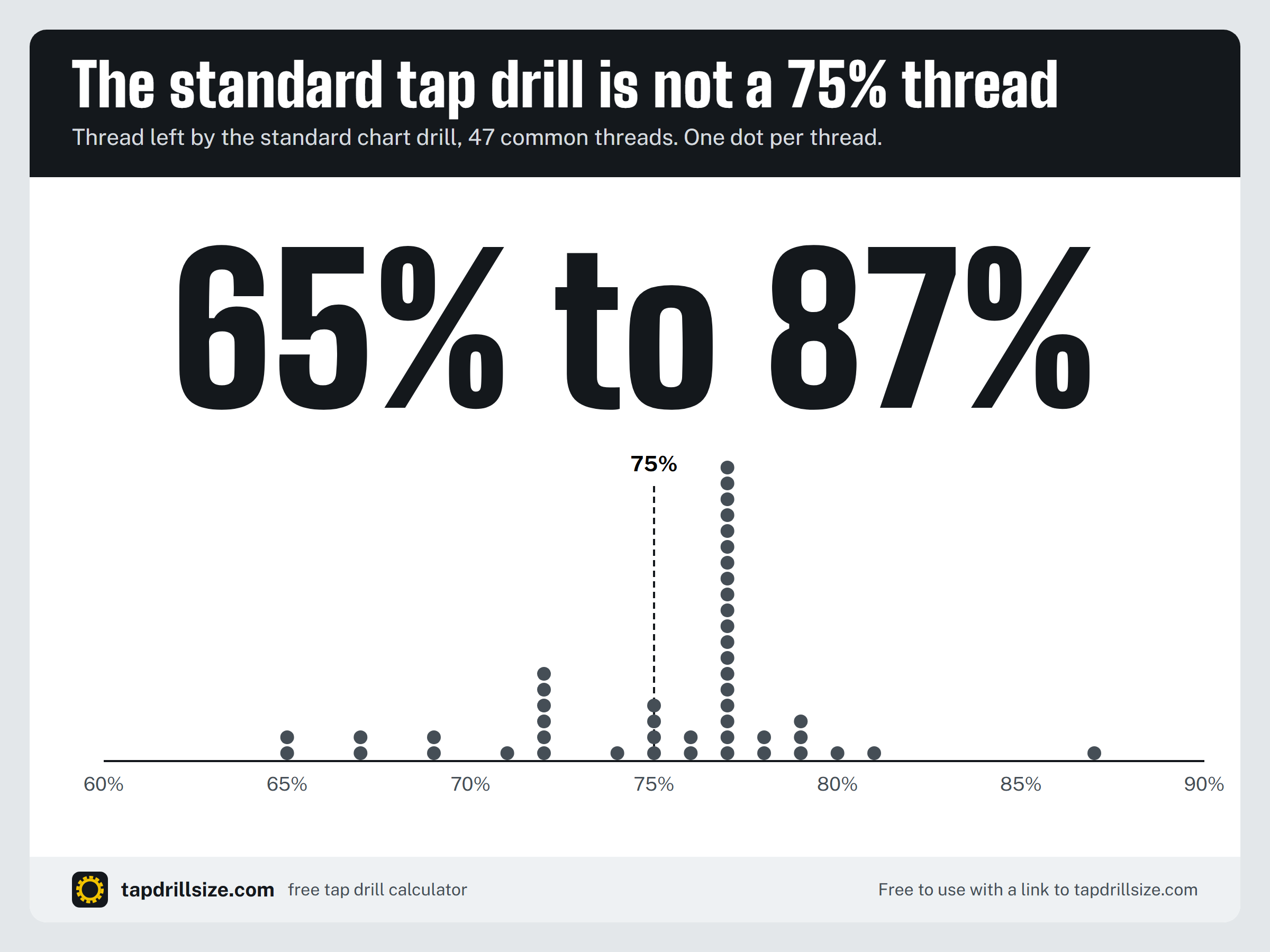
Tap drill charts are drawn up for a 75% thread. Worked out with the formula from OSG's chart, the standard drill for the 47 threads on this site leaves between 65% and 87%. Only five of them land within a point of 75%.
Thread percentage calculator
Type a thread, then choose the drill you have under "Already have a drill?" to see the thread it leaves.
Thread engagement chart for standard tap drills
Every thread on this site with the thread its standard drill leaves. The last two columns compare the drilled hole with the minor diameter limits of the usual thread class, 2B for inch threads and 6H for metric. Highlighted rows are outside them.
| Thread | Standard drill | Thread left | Hole for exactly 75% | Thread the class allows | Hole against the class limits |
|---|---|---|---|---|---|
| #0-80 | 3/64 in | 80.8% | 0.0478 in | 53.0% to 83.1% (2B) | Inside |
| #2-56 | #50 | 69.0% | 0.0686 in | 53.0% to 83.2% (2B) | Inside |
| #4-40 | #43 | 70.8% | 0.0876 in | 55.7% to 83.4% (2B) | Inside |
| #5-40 | #38 | 72.4% | 0.1006 in | 57.9% to 83.4% (2B) | Inside |
| #6-32 | #36 | 77.6% | 0.1076 in | 59.1% to 83.8% (2B) | Inside |
| #6-40 | #33 | 77.0% | 0.1136 in | 58.5% to 83.1% (2B) | Inside |
| #8-32 | #29 | 69.0% | 0.1336 in | 61.6% to 83.8% (2B) | Inside |
| #10-24 | #25 | 74.8% | 0.1494 in | 62.8% to 83.1% (2B) | Inside |
| #10-32 | #21 | 76.4% | 0.1596 in | 64.0% to 83.8% (2B) | Inside |
| #12-24 | #16 | 72.1% | 0.1754 in | 64.7% to 83.1% (2B) | Inside |
| 1/4-20 | #7 | 75.4% | 0.2013 in | 66.2% to 83.1% (2B) | Inside |
| 5/16-18 | letter F | 76.9% | 0.2584 in | 65.8% to 83.8% (2B) | Inside |
| 3/8-16 | 5/16 in | 77.0% | 0.3141 in | 66.5% to 83.8% (2B) | Inside |
| 7/16-14 | letter U | 74.9% | 0.3679 in | 66.3% to 83.5% (2B) | Inside |
| 1/2-13 | 27/64 in | 78.2% | 0.4251 in | 66.0% to 83.1% (2B) | Inside |
| 9/16-12 | 31/64 in | 72.2% | 0.4813 in | 67.0% to 83.6% (2B) | Inside |
| 5/8-11 | 17/32 in | 79.4% | 0.5364 in | 66.9% to 83.0% (2B) | Inside |
| 3/4-10 | 21/32 in | 72.2% | 0.6526 in | 67.0% to 83.1% (2B) | Inside |
| 7/8-9 | 49/64 in | 75.8% | 0.7667 in | 67.2% to 83.1% (2B) | Inside |
| 1/4-28 | #3 | 79.8% | 0.2152 in | 64.7% to 84.1% (2B) | Inside |
| 5/16-24 | letter I | 74.8% | 0.2719 in | 65.6% to 84.1% (2B) | Inside |
| 3/8-24 | letter Q | 79.4% | 0.3344 in | 64.7% to 83.1% (2B) | Inside |
| 7/16-20 | 25/64 in | 72.2% | 0.3888 in | 65.4% to 83.9% (2B) | Inside |
| 1/2-20 | 29/64 in | 72.2% | 0.4513 in | 66.2% to 83.1% (2B) | Inside |
| 9/16-18 | 33/64 in | 65.0% | 0.5084 in | 65.8% to 83.8% (2B) | Over the max by 0.0006 in |
| 5/8-18 | 37/64 in | 65.0% | 0.5709 in | 65.1% to 83.1% (2B) | Over the max by 0.0001 in |
| 3/4-16 | 11/16 in | 77.0% | 0.6891 in | 66.5% to 83.8% (2B) | Inside |
| 7/8-14 | 13/16 in | 67.4% | 0.8054 in | 65.7% to 83.0% (2B) | Inside |
| 1/2-28 | 15/32 in | 67.4% | 0.4652 in | 64.7% to 84.1% (2B) | Inside |
| 5/8-24 | 37/64 in | 86.6% | 0.5844 in | 64.7% to 83.1% (2B) | Under the min by 0.0019 in |
| M2 | 1.6 mm | 77.0% | 1.61 mm | 61.8% to 83.3% (6H) | Inside |
| M2.5 | 2.05 mm | 77.0% | 2.06 mm | 61.9% to 83.3% (6H) | Inside |
| M3 | 2.5 mm | 77.0% | 2.51 mm | 61.7% to 83.3% (6H) | Inside |
| M3.5 | 2.9 mm | 77.0% | 2.92 mm | 62.9% to 83.4% (6H) | Inside |
| M4 | 3.3 mm | 77.0% | 3.32 mm | 63.6% to 83.4% (6H) | Inside |
| M5 | 4.2 mm | 77.0% | 4.22 mm | 64.1% to 83.3% (6H) | Inside |
| M6 | 5.0 mm | 77.0% | 5.03 mm | 65.2% to 83.4% (6H) | Inside |
| M8 | 6.8 mm | 73.9% | 6.78 mm | 67.0% to 83.3% (6H) | Inside |
| M10 | 8.5 mm | 77.0% | 8.54 mm | 67.9% to 83.3% (6H) | Inside |
| M12 | 10.2 mm | 79.2% | 10.30 mm | 68.6% to 83.3% (6H) | Inside |
| M14 | 12.0 mm | 77.0% | 12.05 mm | 68.9% to 83.3% (6H) | Inside |
| M16 | 14.0 mm | 77.0% | 14.05 mm | 68.9% to 83.3% (6H) | Inside |
| M18 | 15.5 mm | 77.0% | 15.56 mm | 69.5% to 83.3% (6H) | Inside |
| M20 | 17.5 mm | 77.0% | 17.56 mm | 69.5% to 83.3% (6H) | Inside |
| M22 | 19.5 mm | 77.0% | 19.56 mm | 69.5% to 83.3% (6H) | Inside |
| M24 | 21.0 mm | 77.0% | 21.08 mm | 70.5% to 83.3% (6H) | Inside |
| M30 | 26.5 mm | 77.0% | 26.59 mm | 71.0% to 83.3% (6H) | Inside |
Why the standard drill is not exactly 75%
A chart works out the hole for a 75% thread, then picks a drill you can buy. Drills come in steps, so the hole lands a little over or under. What that costs depends on the pitch. On #0-80, a hole 0.001 in bigger leaves 6.2 points less thread. On 7/8-9, the same 0.001 in costs 0.7 points.
Number and letter drills fill the gaps between fractions up to the letter Z drill, 0.4130 in. Above that, inch drills come in 1/64 in steps only, which is why 9/16-18, 5/8-18, 7/8-14, 1/2-28 and 5/8-24 land furthest from 75%.
Metric charts use the major diameter minus the pitch. That leaves 77% wherever a drill of that size exists, which is 15 of the 17 metric threads here and most of the tall stack in the chart. Metric drills come in 0.1 mm steps: on M2 one step moves the thread by 19 points, on M30 by 2.
The lowest and the highest
9/16-18 (33/64 in) and 5/8-18 (37/64 in) leave 65%. On an 18-TPI thread a 1/64 in drill step is worth about 22 points, so for 9/16-18 the choice is 33/64 in at 65% or 1/2 in at 87%. The charts take the bigger drill.
5/8-24 is the other end, at 87%. It takes 37/64 in, the same drill as 5/8-18, because the next size up, 19/32 in, would leave 58%.
Thread percentage vs strength
Going below 75% costs little strength. ToolGrit cites studies showing about 90% of a thread's shear strength at 60% thread. Texas Metalworks says going from 75% to 60% costs only about 5% of pull-out strength, and the OSG chart says 55 to 65% thread is enough for most requirements.
A higher percentage costs effort at the tap, because a smaller hole leaves more metal to cut. Regal Cutting Tools, a tap maker, says holding power increases only marginally as thread engagement rises above 60 percent, while the tap torque needed to reach those higher percentages increases exponentially. ToolGrit suggests 50 to 55% for small taps, #6 and below, which break easily. The guides do not agree on how much thread each material needs:
| Material | Texas Metalworks | ToolGrit | OSG (tap maker) |
|---|---|---|---|
| Aluminum | 70-75% | 60-65% | 65-70% |
| Brass | 70-75% | 70-75% | 65-70% |
| Plastic | not covered | 70-75% | not covered |
| Mild steel | 60-65% | 60-65% | 65-70% |
| Stainless steel | 50% | 55-60% | 60-70% |
| Titanium | 50% | 50-55% | not covered |
Our charts use 75% for aluminum, brass and plastics, 60% for mild steel and 50% for stainless steel and titanium. The method page explains how each target becomes a drill.
The limit a drawing can set: thread class
Strength is one limit. A drawing that names a thread class sets another, because the class gives a minimum and a maximum minor diameter for the tapped hole. The OSG chart lists class 2B for general applications. For 1/4-20 the 2B limits are 0.1960 to 0.2070 in, which allows 66.2% to 83.1% thread. A hole over the maximum is out of tolerance for that class, however strong the thread is.
OSG says a higher percentage may be needed to meet the minor diameter limits of the class specified. Our steel drill, aimed at 60%, cuts a hole over the class maximum on 35 of the 47 threads here, and our stainless drill, aimed at 50%, on 45. Use them where the drawing sets no thread class. Where it does, pick a drill inside the limits: every thread page names one.
The standard drill itself is outside the limits on three threads: 9/16-18 and 5/8-18 are just over the maximum, and 5/8-24 is under the minimum. The tap drill charts compared page shows the drills that tap makers give instead.
Thread percentage formula
Thread percentage = (major diameter - drill diameter) / (1.299 x pitch) x 100. For 1/4-20 with a #7 drill: (0.2500 - 0.2010) / (1.299 x 0.0500) = 75.4%.
The OSG chart prints the same formula with threads per inch: percent = TPI x (major diameter - drill) / 0.01299. The hole diameters it gives at 80, 75, 70, 65 and 60% match ours to within 0.0001 in for every UNC and UNF thread on this site, as the method page shows.
FAQ
What is thread percentage?
It is how deep the tapped thread is, as a share of a full thread. A 100% thread needs a hole of the major diameter minus 1.299 times the pitch. A bigger hole leaves a shallower thread and a lower percentage.
What thread percentage does a standard tap drill give?
Between 65% and 87% for the 47 threads on this site, worked out with the formula printed in the OSG chart. Charts aim at 75% and then round to a drill you can buy, so most land a few points over or under.
Is a 60% thread strong enough?
For most work, yes. The OSG chart says 55 to 65% thread is enough for most requirements, ToolGrit cites studies showing about 90% of a thread's shear strength at 60%, and Texas Metalworks says going from 75% to 60% costs only about 5% of pull-out strength. If the drawing calls for class 2B, check the hole against the minor diameter limits first: on 1/4-20 they allow no less than 66.2%.
What thread percentage should I use for stainless steel?
The guides disagree. Texas Metalworks says 50%, ToolGrit 55-60%, and OSG, a tap maker, 60-70% for average work. The lower figures make the tap easier to turn. OSG's figure keeps more of the thread.
Why does 5/8-24 get 87% thread?
5/8-24 takes 37/64 in, the same drill as 5/8-18. The next drill up, 19/32 in, would leave only 58%. No inch drill lands closer to 75%.
Thread percentages use the formula in the OSG tap drill chart, Vol 3 (2024). Hole limits: class 2B limits from the OSG chart (the UNEF threads from the YG-1 chart) and class 6H limits from the Emuge chart. Strength figures from ToolGrit, Texas Metalworks and Regal Cutting Tools on tap drill selection. Drill sizes from Wikipedia: drill bit sizes. Last reviewed October 12, 2026.